
Regional PVS Pathway Orientation Training Workshop in Saint Lucia
April 10, 2026
Vacancy available: PROGRAMME MANAGER, RESEARCH AND RESOURCE ASSESSMENT
April 17, 2026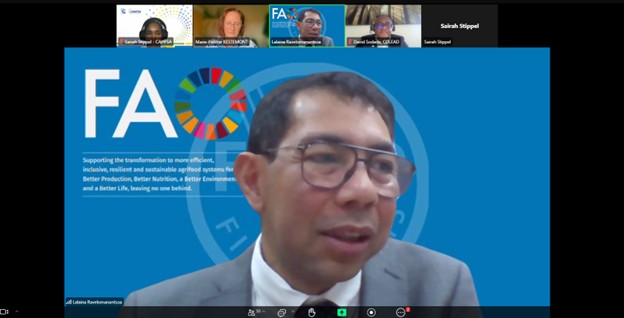
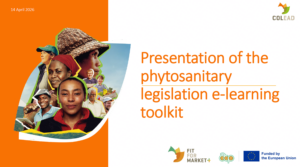
On April 14, the Caribbean Agricultural Health and Food Safety Agency (CAHFSA) co-hosted a significant webinar in collaboration with the Food and Agriculture Organization of the United Nations (FAO) and the Committee Linking Entrepreneurship-Agriculture-Development (COLEAD), funded by the European Union through the Fit for Market Plus (FFM+) programme. The webinar focused on the FAO Phytosanitary Legislation E-Learning Toolkit, which serves as a valuable resource with far-reaching implications for plant health systems across the Caribbean and beyond.
CAHFSA’s representative, Ms Sairah Stippel, warmly welcomed all participants on behalf of the agency, expressing sincere gratitude to FAO and COLEAD for their vision in fostering this partnership. The toolkit was presented by Mr Lalaina Ravelomanantsoa, Legal Officer at FAO, while Mr David Sodade of COLEAD conducted a live demonstration of the e-learning platform. Ms Marie-Hélène Kestemont from COLEAD delivered the closing remarks.
This webinar was timely for plant health systems, as the Caribbean faces challenges associated with increasing trade, climate pressures, and the emergence of pest risks. Consequently, the need for robust, modern, and effective plant health legislation has become more urgent than ever.
In plant health, attention naturally gravitates toward what is visible: pests, crop damage, and outbreaks. Yet underpinning every response, every surveillance programme, and every trade protocol is something far less visible: the legislative framework. When that framework is outdated, unclear, or simply impractical, everything downstream becomes challenging. Enforcement loses its footing, surveillance gaps widen, and trade relationships become strained. Legislation is not merely a necessity; it is the foundation upon which effective plant health systems are built.
For the Caribbean, this is more than a training resource. It is an opportunity to strengthen national systems, enhance regional harmonisation, and better protect agriculture, biodiversity, and trade all in direct alignment with CAHFSA’s mandate to support Member States in improving their SPS systems and advancing a One Health approach.
As CAHFSA continues to work alongside regional and international partners to advance plant health in the Caribbean, initiatives like the FAO Phytosanitary Legislation E-Learning Toolkit are precisely the kind of practical, collaborative investments that move the needle.
About the FAO Phytosanitary Legislation E-Learning Toolkit
The Phytosanitary Legislation E-Learning Toolkit is a self-paced, interactive online course developed by COLEAD in collaboration with the FAO, aligning with the FAO Strategic Framework 2022–2031. This resource is designed to assist countries in modernising their legal and institutional frameworks for plant health. It incorporates guidance from the International Plant Protection Convention (IPPC), insights from the Phytosanitary Capacity Evaluation (PCE) process, and practical technical expertise gathered from various regions and contexts.
The course is structured across seven modules that take learners from foundational principles through to practical application:
- Module 1 — The Importance of Trade in Plants and Plant Products
- Module 2 — The International Context of Phytosanitary Legislation
- Module 3 — Preparation of New or Revised National Phytosanitary Legislation
- Module 4 — Foundations of National Phytosanitary Frameworks
- Module 5 — Operational Aspects of Phytosanitary Legislation
- Module 6 — Other Considerations Related to Phytosanitary Legislation
- Module 7 — Summary, Future Outlook and Tools
Each module makes use of instructional videos, quizzes, case studies, and external resource links to support active, engaging learning.
Who Is It For?
The toolkit is designed for a broad audience, anyone engaged in the plant health sphere, not just those directly responsible for drafting legislation. This includes plant health practitioners, policy actors and decision-makers, lawmakers, law enforcement agents, and expert consultants and trainers working in plant health. During the webinar, participants were walked through the platform’s navigation features, including a quick tutorial, course menu, and support resources, making it highly accessible even for first-time users.
Three Core Objectives
The toolkit works toward three interconnected outcomes. First, it aims to strengthen legal frameworks by improving understanding of and compliance with international obligations, guiding the drafting of clear and enforceable plant health rules, and closing legal gaps that hinder compliance. Second, it builds institutional capacity by equipping National Plant Protection Organisations (NPPOs), regulatory authorities, and enforcement agencies with the practical knowledge to apply laws effectively and shift toward risk-based rather than reactive approaches. Third, it improves compliance and enforcement by training all stakeholders government, industry, inspectors on their obligations and best practices, thereby reducing pest outbreaks and improving plant health awareness across the board.
Access the E-Learning Course
The Phytosanitary Legislation E-Learning Course is open to all professionals working in plant health, SPS systems, and related fields. We strongly encourage you to enrol and share it within your professional networks.
🔗 Access the FAO Phytosanitary Legislation E-Learning Toolkit here